
Dr. Doaa Mohi El-Din: From Artificial Intelligence to Predictive Medicine: A Scientific Vision for a More Humane Medicine
In recent years, teaching methods have undergone a major transformation due to the rapid advancement of Artificial Intelligence (AI) and Generative AI technologies and algorithms. Education is no longer limited to traditional approaches; instead, it increasingly relies on smart technologies that enhance interaction and efficiency in the learning process.
AI technologies contribute to accurately analyzing students’ performance by tracking their learning patterns and academic progress. Based on these analyses, educational systems can provide personalized content tailored to each student’s needs, improving comprehension and understanding.
Egypt is considered one of the countries most interested in Artificial Intelligence, aligning with Egypt Vision 2030 and the country’s digital transformation strategy. AI technologies represent a significant opportunity to develop the education sector and keep pace with global digital transformation. Smart educational platforms allow teachers to continuously monitor student performance and provide interactive tools that improve the learning experience both inside and outside the classroom.
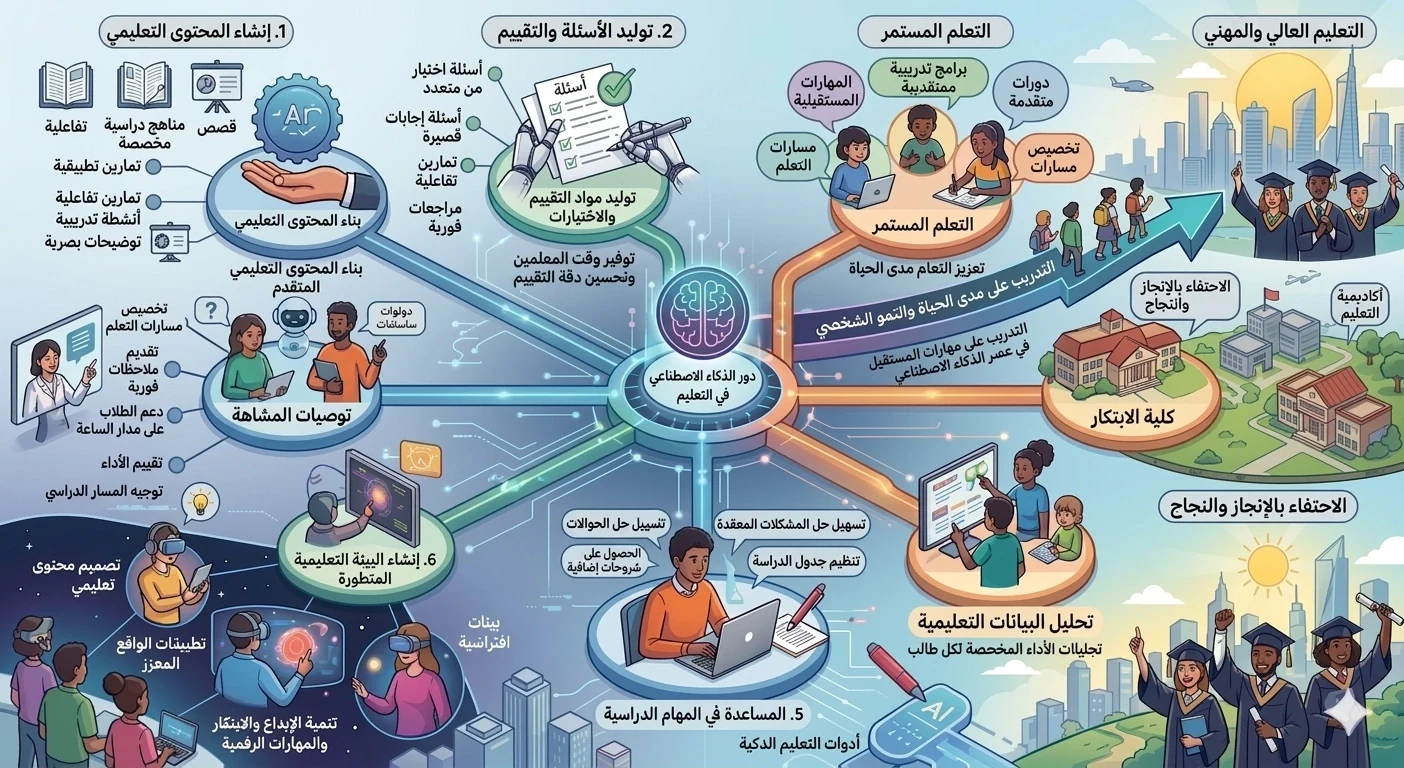
Many generative AI tools and applications have been developed for educational purposes, offering multiple uses in the field of education. These technologies contribute to generating new content such as texts, images, and exams, while supporting teaching and learning processes. Some notable applications include:
Generative AI can produce various educational materials, including:
Simplified lesson explanations
Study summaries
Educational presentations
This enables faculty members and teachers to prepare lessons quickly and in diverse formats.
Generative AI can create:
Multiple-choice questions
Short-answer questions
Practice exercises
This helps teachers evaluate students efficiently using different assessment methods.
Generative AI contributes to delivering educational content tailored to each student’s level by:
Suggesting additional exercises for students who need support
Providing explanations adapted to varying levels of understanding
Students can also benefit from generative AI tools in several areas, such as:
Writing essays and research papers
Correcting language and grammar mistakes
Suggesting ideas for academic topics
Generative AI can generate:
Illustrative images for scientific concepts
Educational videos
Interactive simulations that help students understand complex concepts
Some systems provide virtual assistants capable of:
Answering students’ questions at any time
Explaining lessons in simplified ways
Guiding students toward suitable learning resources
Generative AI contributes significantly to advancing education by creating new content, supporting teachers and faculty members, and providing a more interactive learning experience aligned with students’ needs.
Education experts believe that one of today’s most important investments is integrating AI into education across schools, colleges, universities, and institutes to modernize curricula. Through this approach, it is possible to prepare a generation equipped with critical thinking, innovation, and technological skills. As the world moves toward a knowledge-based economy, developing smart education has become an essential step in building a competitive digital society. Preparing a generation that is digitally literate and academically qualified is fundamental to achieving a more advanced and prosperous future.
A Pioneer in Artificial Intelligence and Data Science in Egypt
Academic Achievements and Inspiring Leadership in Artificial Intelligence and International Competitions