12 Trends Reshaping the Future of Artificial Intelligence
When Medicine Does Not Wait for Disease to Appear… but Begins Searching for It Before It Does
What if technology could detect subtle signals in the human body before they develop into disease?
What if a physician could examine thousands of medical indicators within moments and identify a pattern that the human eye might not easily detect?
And what if artificial intelligence became a means not only of treating disease, but of preventing a person from reaching that stage in time?
These questions lie at the heart of one of the most exciting transformations in the future of medicine: AI-powered predictive medicine.
Within this rapidly evolving scientific landscape, Dr. Doaa Mohi El-Din’s vision stands out. She views artificial intelligence as more than a modern technology; she sees it as a bridge connecting computer science with medicine and biological sciences, and as a means of building a healthcare system that is smarter, more precise, and most importantly… more human-centered.
From Treating Disease to Anticipating It
Traditional medicine often begins its journey when symptoms appear. Predictive medicine, however, seeks to begin earlier.
This is where the power of artificial intelligence emerges.
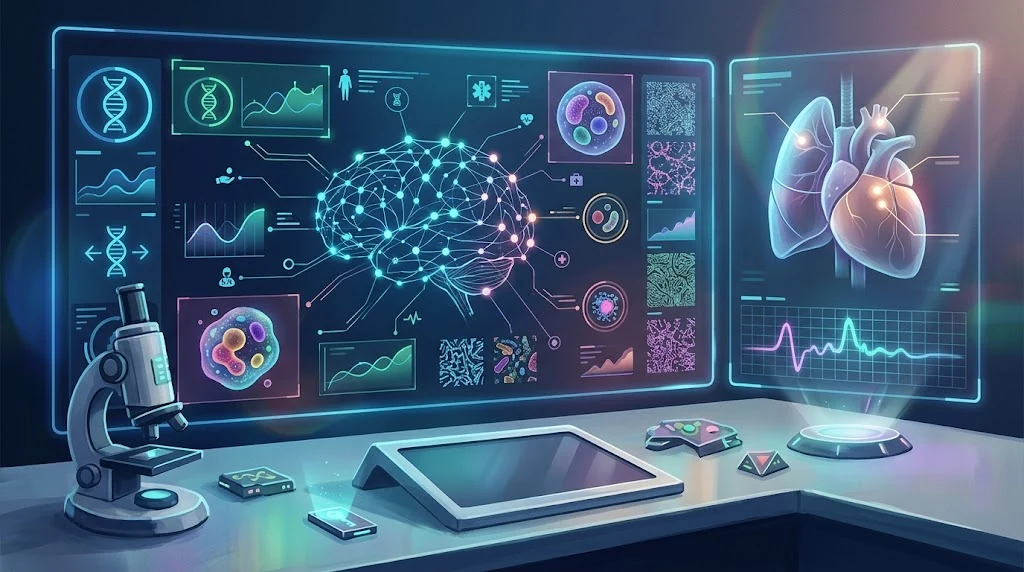
Modern algorithms can process vast amounts of medical data, analyze images, tests, biomarkers, and health records, and search for patterns that may carry early signals of health risks.
This capability opens the door to a fundamental shift:
From the question “What disease does the patient have?”
to a more ambitious question: “What could happen to this patient in the future, and how can we prepare for it early?”
Dr. Doaa believes that this transformation represents one of the most important forms of value that artificial intelligence can offer humanity when it is applied scientifically and responsibly.
When Artificial Intelligence Meets Stem Cells
One of the fields that most clearly demonstrates the scale of this future is stem cell research and regenerative medicine.
Stem cells contain enormous amounts of complex biological information, and analyzing their characteristics, changes, and behavior requires tools capable of processing large volumes of data, images, and patterns.
Here, artificial intelligence can become a powerful tool for researchers in analyzing cellular images, classifying cells, studying patterns of growth and differentiation, and linking biological data with disease-related indicators.
It is a meeting point between two worlds:
the intelligence of machines in discovering patterns…
and human intelligence in interpreting them and transforming them into knowledge.
This type of research opens the door to broader collaboration among computer science, medicine, biological sciences, and bioengineering, supporting the future of regenerative medicine, drug discovery, and the study of complex diseases.
But… Is Accuracy Enough?
Here appears the issue that Dr. Doaa places at the heart of her vision:
Not every accurate model is a trustworthy model.
In medicine, it is not enough for a machine to say that the probability of a disease is high.
The more important question is: Why did it say that?
This is where the importance of Explainable AI emerges, helping physicians and researchers understand the factors that influenced the model’s result.
The closer artificial intelligence gets to human life and health, the more necessary it becomes for it to be transparent, understandable, and aligned with ethical standards.
Artificial Intelligence… but Humans First
Dr. Doaa’s vision is not based on replacing the physician with the machine.
Quite the opposite.
The physician possesses human experience, the ability to understand the patient’s circumstances, communicate with them, and assess psychological and social dimensions. Artificial intelligence, meanwhile, possesses exceptional capabilities for analyzing data and detecting patterns.
When both work together, a more powerful system can emerge.
The machine analyzes…
The physician interprets…
And the human decides.
This is the philosophy of more human-centered medicine.
From Technology to Ethical Responsibility
The greater the ability of artificial intelligence to predict disease, the greater the responsibility placed on scientists and developers.
Patient data is not merely numbers.
It represents lives, privacy, and rights.
Therefore, data protection, privacy, fairness, reducing algorithmic bias, and scientific validation of models become elements that are just as important as the accuracy of the algorithm itself.
This is where the ethical vision of artificial intelligence emerges, emphasizing that true innovation is measured not only by what technology can do, but also by what it should do.
A University That Creates the Future… Rather Than Waiting for It
The future of medical artificial intelligence cannot be built through technology alone.
The future requires people who are capable of understanding technology and applying it responsibly.
This is where the university plays its role in preparing a new generation of students and researchers who can work at the intersection of artificial intelligence, medicine, and scientific research.
Through Dr. Doaa’s interest in developing artificial intelligence programs, quality assurance, academic advising, leading teams and projects, and supporting training and research activities, an educational vision takes shape that goes beyond the boundaries of the curriculum toward preparing students capable of addressing real-world problems.
The artificial intelligence student of the future will not only be expected to know how to build an intelligent model, but also to know:
When should it be used?
Why should it be used?
How should it be tested?
Who protects it?
And who bears responsibility for its outcomes?
Here, academic leadership transforms from managing an academic program into shaping the future.
From the Algorithm to the Impact
The true power of artificial intelligence does not lie in the complexity of the algorithm, but in the impact it can make on human life.
One algorithm may help detect an early pattern.
Another may help analyze a medical image.
A third may contribute to predicting the risk of a particular disease.
But the ultimate value does not lie in the algorithm itself, but in the person who may gain a better opportunity for treatment, an opportunity for early detection, or an opportunity for a higher quality of life.
Here, Dr. Doaa Mohi El-Din’s vision takes shape:
advanced artificial intelligence,
multidisciplinary scientific research,
responsible academic leadership,
a clear ethical vision,
and a human being who always remains at the center of the system.
The Future Begins Before the Disease Appears
Perhaps the greatest transformation artificial intelligence will bring to medicine is that it will change our very concept of disease.
The question will no longer be only: How do we treat?
But rather:
How do we predict?
How do we detect early?
How do we prevent?
And how do we make medicine more precise without losing its humanity?
These are not merely technical questions, but questions about the future of humanity.
This is why it is essential to build scientific and academic leadership capable of bringing together technology, scientific research, quality, management, and ethics, and directing all of them toward one goal:
for artificial intelligence to serve humanity… not for humanity to serve artificial intelligence.