
12 Trends Reshaping the Future of Artificial Intelligence
By Dr. Doaa Mohi El-Din, Faculty Member at the Faculty of Computers and Information Systems and Consultant in Artificial Intelligence and Data Science
A Consulting Vision: Why the Future of Energy Will Not Belong Only to Those Who Possess Artificial Intelligence, but to Those Who Can Understand It and Trust Its Decisions
The energy sector is undergoing one of the most profound transformations in its history. With the expansion of renewable energy sources, the growing reliance on smart grids, and the increasing volume of data coming from power generation stations, consumers, and sensors, artificial intelligence has become an essential element in managing the modern energy ecosystem.
But a more important question has begun to impose itself on decision-makers:
Can we rely on an artificial intelligence system to make an energy-related decision if we do not understand why it made that decision?
This is where the importance of Explainable AI – XAI emerges. It does not merely provide a prediction or recommendation, but seeks to clarify the factors that led to the result.
This transformation may have an impact that extends beyond the energy sector itself to investment, industry, trade, inflation, national security, and global economic growth.
Why Does the Energy Sector Specifically Need Explainable Artificial Intelligence?
The energy sector is not merely a commercial market.
It is a strategic infrastructure upon which nearly all other sectors depend.
Any error in forecasting demand, energy production, distribution, or grid management can lead to widespread economic losses.
Artificial intelligence can help with:
– Forecasting electricity demand.
– Forecasting solar and wind energy production.
– Detecting failures before they occur.
– Improving maintenance operations.
– Managing loads.
– Detecting abnormal patterns.
– Improving energy distribution.
– Reducing losses.
– Supporting investment decisions.
But when the decision concerns critical infrastructure, simply having the system say:
“This is the best decision”
is not enough.
The decision-maker needs to know:
Why?
From Black Box to Decision Intelligence
Traditional artificial intelligence models may be highly accurate, but sometimes produce results that are difficult to interpret.
In the energy sector, for example, a system may predict a sudden increase in demand.
The question here is not only:
“Is the prediction correct?”
but also:
“What factors led to this prediction?”
Was it caused by rising temperatures?
Was there a change in consumer behavior?
Is increased industrial activity expected?
Has the consumption pattern changed?
Are there indicators related to energy prices?
When the system can provide a logical explanation for its decision, the use of artificial intelligence becomes more trustworthy and reviewable.
Here, artificial intelligence moves from being merely Predictive AI to becoming part of a Decision Intelligence ecosystem.
Renewable Energy.. Where Explanation Becomes Even More Important
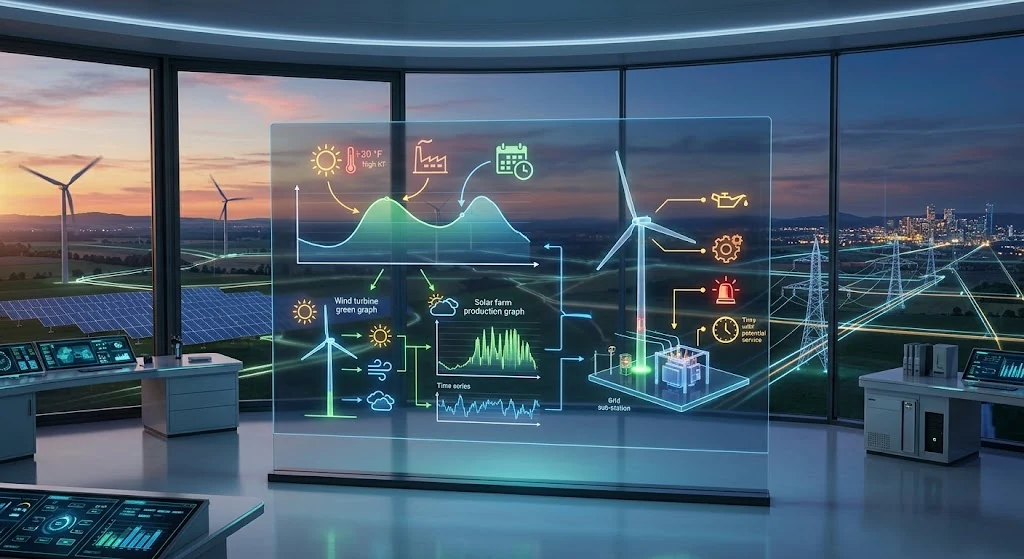
Solar and wind energy present a particular challenge because their production depends on variable factors such as weather, solar radiation, and wind speed.
Artificial intelligence can analyze these variables and forecast expected production.
But imagine that a model predicts a drop in the output of a solar power plant tomorrow.
The decision-maker needs to know why.
Is it due to weather changes?
Or reduced solar radiation?
Or a problem with one of the plant’s components?
Or a historical pattern detected by the model?
This ability to explain the prediction helps transform artificial intelligence from a forecasting tool into a risk management tool.
Predictive Maintenance.. Millions of Dollars That Could Be Saved
One of the most economically important applications of artificial intelligence in energy is Predictive Maintenance.
Instead of waiting for a turbine, transformer, or part of a power plant to fail, the system can analyze operational data and detect indicators that may be associated with the likelihood of failure.
Here, XAI can clarify:
Which variables indicate risk?
Is the problem related to temperature?
Or vibration?
Or a change in the operating pattern?
Or declining performance?
The clearer the explanation, the easier it becomes for maintenance teams to make the right decision at the right time.
The potential result:
fewer failures + lower maintenance costs + greater reliability + improved continuity of production.
How Does the Impact of Artificial Intelligence in Energy Reach the Global Economy?
This is where the larger issue lies.
Energy is involved in nearly every economic activity.
When the cost of producing, distributing, or managing energy decreases, the effects can spread across multiple sectors.
The chain of impact can be envisioned as follows:
AI + XAI
↓
Higher energy efficiency
↓
Lower operating costs
↓
Lower production costs
↓
Greater industrial competitiveness
↓
More stable prices
↓
New investments
↓
Economic growth
This means that investing in artificial intelligence for energy is not merely a technological investment, but can become an investment in the competitiveness of the economy.
Artificial Intelligence and Energy Security
There is another equally important dimension: energy security.
Countries that can forecast demand and production, detect risks early, and manage grids efficiently become better able to withstand disruptions.
This becomes critically important in a world where:
energy + geopolitics + trade + cybersecurity + the economy
are increasingly interconnected.
Therefore, artificial intelligence can become one of the components of countries’ economic and strategic security.
However, this use also makes it necessary to protect artificial intelligence systems themselves from cyberattacks and data manipulation.
Can XAI Contribute to Market Stability?
Energy markets are highly sensitive.
Any major change in supply or demand expectations can affect prices and, consequently, the costs of transportation, industry, and production.
If forecasting systems become more accurate and explainable, they can help companies, institutions, and policymakers understand the factors behind expected changes.
But an important point must be emphasized:
Artificial intelligence cannot eliminate economic uncertainty.
It can only help manage it more effectively.
This is a fundamental principle when dealing with artificial intelligence as a consulting tool: the goal is not to promise the decision-maker certainty, but to improve the quality of the information upon which the decision is based.
Investment in Energy.. When Explaining the Decision Becomes an Economic Asset
An investor does not only want to know that an artificial intelligence model predicts the success of a particular project.
The investor also wants to know:
Why?
What factors was the prediction based on?
What is the level of confidence?
What are the alternative scenarios?
What happens if the energy price changes?
What happens if demand changes?
What happens if climatic conditions change?
Here, Explainable AI can support the development of more transparent models for evaluating risks and opportunities.
As a result, explanation itself becomes an economic value.
But There Is a Risk We Must Not Ignore
The greater the reliance on artificial intelligence, the greater the need for governance.
Data may be biased.
Models may make mistakes.
Future conditions may differ from historical data.
And a system may provide a recommendation that appears logical but is inappropriate in a particular context.
Therefore, the goal should not be:
Automated Decision Making
in an absolute sense.
But rather:
AI-Augmented Decision Making
meaning decision-making supported by artificial intelligence, while humans remain able to understand, review, and evaluate the associated risks.
This is where the importance of:
Human-in-the-Loop + Explainable AI + AI Governance.
becomes clear.
Toward a Smarter and More Human-Centered Energy Ecosystem
The future vision is not simply to build an electricity grid that uses artificial intelligence.
Rather, it is to build an energy ecosystem that:
learns from data,
predicts risks,
explains its decisions,
adapts to changes,
and supports humans in decision-making.
Here, Explainable AI becomes the link between technology and the decision-maker.
Conclusion: Energy May Be One of the Most Important Testing Grounds for Responsible Artificial Intelligence
If artificial intelligence is one of the engines of the digital economy, energy is the infrastructure that allows this economy to function.
Therefore, the combination of artificial intelligence and energy may become one of the most important determinants of the competitiveness of countries and companies in the coming years.
But the advantage will not belong to those who use the largest number of artificial intelligence algorithms.
The advantage will belong to those who can build systems that are:
accurate, explainable, secure, reviewable, and capable of supporting decision-making.
This is where the importance of Explainable AI comes in:
because it does not merely tell us “what will happen”… it attempts to explain “why it will happen,” and what we can do now.
In a world where energy is becoming more complex, markets more interconnected, and economies more dependent on data, investing in Explainable AI for Energy may not merely be an investment in technology.
It may instead be an investment in:
energy security, competitiveness, market stability, and the efficiency of the global economy.
Here, artificial intelligence transforms from a technical tool into one of the components of the economic infrastructure of the future.