
12 Trends Reshaping the Future of Artificial Intelligence
Dr. Doaa Mohi El-Din Presents a New Vision for Using Digital Twins to Determine Responsibility for Errors in Intelligent Systems
From the Self-Driving Car to a “Digital Courtroom” That Reconstructs the Decision Moment by Moment
Artificial intelligence is no longer merely a technology that helps humans with research, analysis, or prediction; it is increasingly becoming involved in decisions that directly affect human life.
A car that moves without a driver, an aircraft that relies on intelligent systems, a medical device that suggests a diagnosis, a robot operating inside a factory, or an intelligent system managing an energy grid.
But as the level of machine autonomy increases, a highly sensitive question emerges:
If artificial intelligence makes a wrong decision and causes harm.. who is legally responsible?
Is it the user?
Or the manufacturer?
Or the software developer?
Or the artificial intelligence engineer?
Or the data provider?
Or the maintenance provider?
Or was the error the result of several factors interacting at the same time?
Here, the vision of Dr. Doaa Mohi El-Din, Faculty Member at the Faculty of Computers and Information Systems and Consultant in Artificial Intelligence and Data Science, emerges toward employing artificial intelligence, digital twins, and Explainable AI to build a more objective model for analyzing responsibility in the age of autonomous systems.
When the Human Hand Disappears from the Steering Wheel
Let us imagine an accident involving a self-driving car.
There was no driver pressing the brakes.
The car made the decision itself.
But this decision did not come from a “single machine” in the simple sense.
Behind the decision lies an entire system:
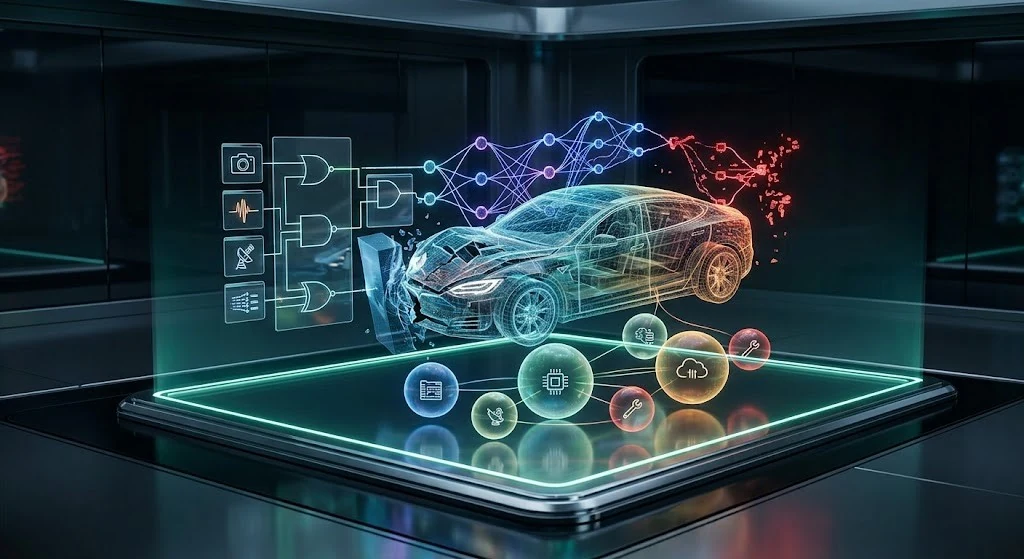
Sensors → Cameras → Data → Maps → Algorithms → AI Model → Control Software → Braking and Steering System → Maintenance and Updates.
Therefore, when an accident occurs, assigning responsibility directly to one person may be an extreme simplification of a complex technical incident.
The correct question should be:
“Where did the error occur within the decision-making chain?”
And who could have prevented it?
The Digital Twin.. A Digital Witness to What Happened
Here, the Digital Twin can play a new role that goes beyond its traditional applications.
A digital twin of the accident can be created to reconstruct the conditions preceding the incident moment by moment.
It can receive:
– Camera data.
– Radar and LiDAR data.
– Vehicle speed.
– Location.
– Road conditions.
– Weather data.
– Maps.
– Driving system decisions.
– Braking commands.
– Steering commands.
– Software version.
– Maintenance records.
– Sensor data.
– Any human intervention.
The system then reconstructs the scenario:
What did the car see?
What did the system understand?
What decision did it make?
When did it make that decision?
And why did it make it?
Here, the digital twin becomes what may be described as:
“The Digital Scene of the Accident.”
From Reconstructing the Accident to Reconstructing the Decision
The most important step is not only knowing what happened, but understanding how the system reached the decision that led to the accident.
This is where Explainable AI comes into play.
Instead of the system presenting an ambiguous result such as:
““The decision was 85% correct.””
we need to know:
What data did it rely on?
What factors influenced the decision?
What was the confidence level?
Was any data missing?
Did the system misclassify an object in front of it?
Was there a problem with a sensor?
Was the AI model operating on an outdated version?
Was the environment outside the scope of the training data?
Each of these answers could change the course of determining responsibility.
The More Critical Question: What If the Error Had Not Occurred?
Here, one of the most powerful tools that a digital twin can provide emerges:
Counterfactual Simulation
meaning the simulation of an alternative scenario.
We ask the system:
What would have happened if the error had not occurred?
What if:
– The camera had been working more effectively?
– The model had been trained on this type of situation?
– The map had been updated?
– The system had received a software update?
– Maintenance had been performed on time?
– A human had intervened at the right moment?
If the accident disappears in one of these scenarios, we obtain important technical evidence about the causal relationship.
Here, we move from the question:
““Who made the mistake?””
to a more scientific question:
““Was the error a necessary or significant cause of the accident?””
From Individual Responsibility to Distributed Responsibility
In complex intelligent systems, there may not be a “single party at fault.”
Responsibility may be distributed among several parties.
Therefore, a Liability Contribution Index can be developed based on a group of factors, such as:
strength of the causal relationship + degree of fault + ability to control + ability to prevent the accident.
In this way, the relative technical contribution of each party can be determined.
For example, an investigation may reveal that:
a problem in the AI model contributed to the decision,
but the problem was worsened by a malfunction in one of the sensors,
and the malfunction could have been detected during maintenance,
while the system also lacked an appropriate safety mechanism.
Here, responsibility is no longer a simple story between “human and machine.”
It becomes a network of causal relationships.
But Does the Technical Percentage Mean Legal Responsibility?
Here, a clear dividing line must be established.
If the model concludes that one party technically contributed 60% to the accident, this does not automatically mean that the law will hold that party responsible for 60% of the legal liability.
Because:
Technical responsibility ≠ Legal responsibility.
The model can assist in:
reconstructing the incident, identifying causation, analyzing evidence, and estimating the contribution of different parties.
However, determining final legal responsibility remains dependent on the applicable law, the nature of the legal relationship, rules of evidence, governing regulations, and the decision of the competent judicial authority.
This distinction is essential so that artificial intelligence does not become an “automated judge.”
Who Is Responsible for the Artificial Intelligence Itself?
The issue becomes even more complex when the error lies within the intelligent system itself.
Is the problem in:
the data?
Or in:
the algorithm?
Or in:
the training method?
Or in:
system testing?
Or in:
the software update?
Or in:
the way the system was integrated into the vehicle?
Or in:
the way the system was operated?
Therefore, determining responsibility requires full traceability across the system’s life cycle:
Data → Design → Training → Testing → Deployment → Update → Operation → Maintenance
Each stage may contain a different point of failure.
Toward an “AI Decision Record”
From here, another idea emerges that may become an essential component of future systems:
AI Decision Audit Trail
meaning a digital record that preserves the history of important decisions made by the system.
For example:
14:35:21
The system detected an object in front of the vehicle.
14:35:22
The object was classified as non-hazardous.
14:35:23
The system decided not to apply the brakes.
14:35:24
The vehicle continued moving.
14:35:25
The collision occurred.
This record can help investigators, experts, and judicial authorities understand the decision-making journey instead of looking only at its final outcome.
From “Who Made the Mistake?” to “Who Could Have Prevented the Mistake?”
This may be the most important shift in thinking.
Responsibility should not only search for the person whose name is associated with the error, but also for:
Who knew about the risk?
Who had the ability to control it?
Who could have detected the problem?
Who could have prevented the accident?
And who failed to take the appropriate action?
Here, the concept of Preventability becomes an important element in analyzing responsibility.
If a party possessed the knowledge, capability, and means to prevent the accident but failed to do so, this information may be highly significant in the legal assessment, depending on the applicable law.
The Digital Twin as a Tool for Justice in the Age of Artificial Intelligence
The future may witness systems that use digital twins not only to design cars, factories, or cities, but also to understand complex accidents resulting from interactions between humans, machines, software, and data.
Here, the system can operate in four stages:
Reconstruction
Reconstructing the incident.
Explanation
Explaining artificial intelligence decisions.
Counterfactual Simulation
Testing alternative scenarios.
Causal Attribution
Determining the causal contribution of each element.
The results are then presented to experts and competent authorities to make the legal decision.
Artificial Intelligence Should Be Neither the Accused nor the Judge
It would be incorrect to say:
““Artificial intelligence made the mistake, therefore artificial intelligence is responsible.””
Artificial intelligence, in most current legal frameworks, is not a natural or legal person that bears responsibility merely because it is a technical system.
Responsibility is directed toward the persons and legal entities connected to the design, production, operation, maintenance, or use of the system, depending on the relevant legal framework.
Therefore, the goal of technology is not to create an “automated defendant,” but to provide more accurate and transparent evidence and analysis.
A Future Vision: From AI to Responsible AI
This issue introduces a concept far broader than self-driving cars alone.
As artificial intelligence becomes increasingly involved in:
medicine, energy, aviation, industry, banking, transportation, smart cities, and cybersecurity,
there will be a growing need for systems capable of explaining decisions and tracing responsibility when errors occur.
Here:
Explainable AI + Digital Twin + Causal AI + AI Governance
become part of the fundamental infrastructure of responsible artificial intelligence.
Conclusion
In the age of autonomous systems, the legal question will no longer be as simple as:
“Who was driving?”
Instead, it will become:
Who designed?
Who trained?
Who tested?
Who updated?
Who operated?
Who maintained?
Who knew?
And who could have prevented the accident?
From here, Dr. Doaa Mohi El-Din’s vision emerges toward employing digital twins and Explainable AI to build a system capable of reconstructing the accident, understanding the decision, testing alternative scenarios, and determining the causal contribution of each element.
It is a shift from:
Black Box → Explainable AI
and from:
Accident Investigation → Digital Reconstruction
and from:
Fault Attribution → Causal Liability Analysis
Ultimately, artificial intelligence should not judge humans.
Rather, it should help humans reach a clearer truth, more examinable evidence, and fairer accountability.
The more autonomous the machine becomes… the more intelligent the accountability system must become.