

Dr. Doaa Mohi El-Din: From Artificial Intelligence to Predictive Medicine: A Scientific Vision for a More Humane Medicine
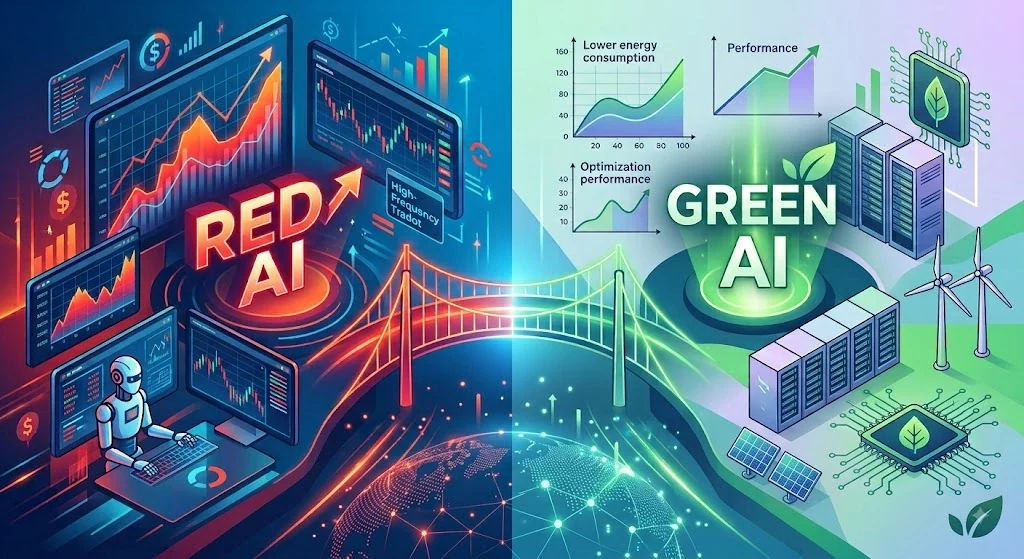
The world of the digital economy and finance (FinTech) is undergoing a profound transformation with the rapid expansion of Artificial Intelligence—not only in data analysis and decision-making, but also in shaping the core infrastructure of modern financial markets.
In this context, two important and evolving concepts have emerged: Red AI and Green AI, serving as frameworks to understand the balance between massive computational power and economic/environmental sustainability.
The concept of Red AI refers to models that rely on maximum computational power and data to achieve the highest possible accuracy, even at the expense of high energy and resource costs.
This type of AI dominates fields such as:
High-Frequency Trading (HFT)
Real-time global market analysis (where speed and critical accuracy are the top priority)
In contrast, Green AI focuses on efficiency, sustainability, and reducing energy consumption without significant sacrifice to performance. This is a growing trend within the FinTech sector, especially with the rising operating costs of data centers and regulatory pressures regarding the carbon footprint of financial institutions.
In recent years, financial institutions have realized that competition is no longer just about prediction accuracy, but also about the “cost of intelligence” itself:
How much energy do these models consume?
How much does it cost to run them?
Can the same results be achieved with higher efficiency?
Here, the balance between Red and Green AI emerges as a strategic element in developing smarter, more sustainable financial systems.
In FinTech specifically, Red AI has become essential in applications such as:
Real-time financial fraud detection
Complex credit risk analysis
Automated trading in global markets
High-accuracy currency and stock movement forecasting
However, this massive expansion comes with a high price tag in terms of energy, infrastructure, and operational complexity, making complete reliance on the “Red Model” unsustainable in the long run.
On the other hand, Green AI offers a more balanced vision by developing smaller, more efficient models that rely on techniques such as:
Resource consumption reduction without losing core performance
Recent studies up to 2026 show that integrating sustainability principles into AI within the financial sector helps reduce operational costs and improve long-term efficiency while maintaining regulatory compliance and Environmental, Social, and Governance (ESG) standards.
The real challenge in FinTech today is not choosing one model over the other, but building a Hybrid AI model that combines the precision of Red AI with the efficiency of Green AI. Modern financial institutions need powerful systems capable of handling massive amounts of real-time data without consuming unnecessary resources or driving operational costs to unsustainable levels.
Recent research trends indicate that the future of AI in the economy will not be built solely on performance, but on three main pillars: Accuracy, Efficiency, and Sustainability. This shift redefines the concept of value in the digital economy, where “intelligence efficiency” becomes part of the financial valuation itself, rather than a minor technical factor.
Furthermore, integrating AI into FinTech paves the way for fairer and more transparent financial systems, provided algorithmic bias is controlled and interpretability is ensured—so that financial decisions do not turn into an unaccountable “black box.”
Ultimately, Red AI and Green AI are not opposing directions; they are two wings driving a single future:
One wing drives innovation, speed, and computational power.
The other wing drives sustainability, efficiency, and responsibility.
Between them, the future of FinTech is being shaped—where it is no longer enough for a financial system to be just smart, but smart… responsible… and sustainable.
Written by:Dr. Doaa Mohie El-Din, AI and Data Science Expert & Consultant, AI Faculty Member.