Dr. Doaa Mohi El-Din: From Artificial Intelligence to Predictive Medicine: A Scientific Vision for a More Humane Medicine
From the “Cage” to the “Cognitive Environment”: A New Generation of Animal Protection with Artificial Intelligence
By Dr. Doaa Mohi El-Din, Faculty Member at the Faculty of Computers and Information Systems and Consultant in Artificial Intelligence and Data Science
In the age of artificial intelligence, the question is no longer: How can we monitor animals?
Cameras can monitor, sensors can measure, and digital systems can record.
But the more important question is:
Can we build a system that can “understand” an animal’s needs, detect danger before it occurs, and intervene to protect it without turning its life into a continuous surveillance experiment?
From here, a new concept in animal care can begin:
Cognitive Animal Protection
That is, cognitive protection for animals; where artificial intelligence is not merely an electronic eye, but rather a system that learns from behavior, environment, and history, and helps humans make the right decision at the right time.
From the Cage to the “Smart Environment”
The primary function of the traditional cage is separation and protection.
But this concept may become limited in the age of technology.
A modern environment for an animal should not merely be an enclosed space, but rather a living system that responds to its needs.
The new generation can be envisioned as follows:
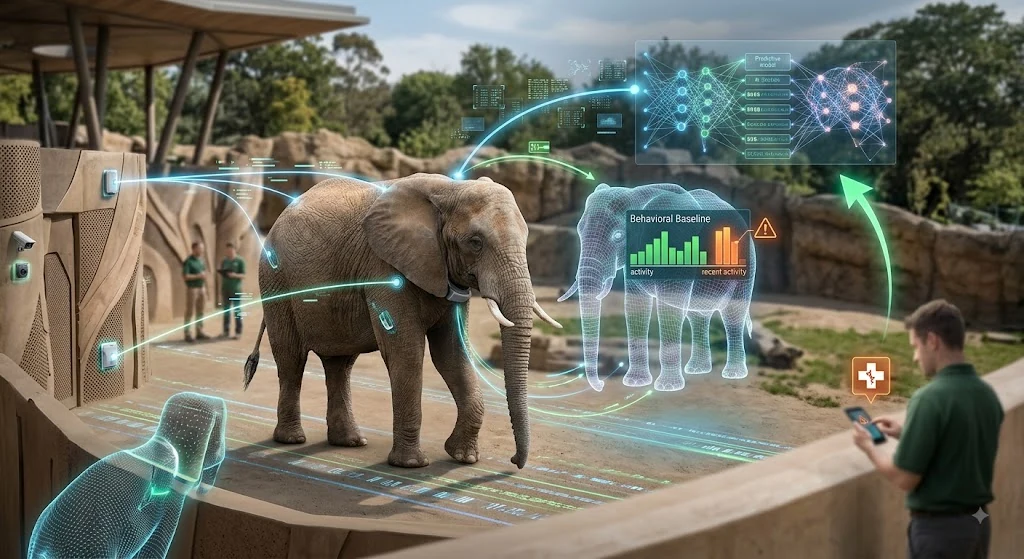
Animal → Sensors → AI → Digital Twin → Risk Analysis → Alert → Human Intervention
The animal interacts with the environment, sensors collect data, artificial intelligence analyzes patterns, and the digital twin represents the animal’s current condition. The system then evaluates risks and sends an alert to the specialist.
Here, technology shifts from:
Monitoring
to:
Understanding & Protection
The Animal Cannot Say “I Am Tired”
This is one of the most important strengths of artificial intelligence in this field.
A human can say:
“I feel pain.”
But an animal cannot express its condition in words.
Therefore, veterinary care depends on observation, experience, and examination.
This is where artificial intelligence can become an additional layer of observation.
Not to replace the veterinarian, but to help them see what may be difficult to detect continuously.
The system can learn the animal’s normal pattern:
How does it move?
When does it eat?
When does it sleep or rest?
How does it interact?
What is its usual level of activity?
How does its behavior change under different conditions?
Then it monitors deviations from this pattern.
The problem is not always “abnormal behavior”..
Sometimes, it is a change from the normal behavior of that specific animal.
This is where personalized artificial intelligence for animals begins.
Every Animal Has a “Digital Fingerprint”
A dynamic profile can be built for each animal, rather than merely a card containing its name, age, and species.
Instead:
Animal Digital Profile
which evolves over time.
It includes:
behavior + nutrition + activity + environment + health history + veterinary observations + response to changes.
As data accumulates, the system can establish a:
Behavioral Baseline
meaning a baseline for the animal’s behavior.
Then the question:
“Is the animal normal?”
becomes less precise than:
“Is the animal behaving today the way we have come to expect from it?”
This is a fundamental difference in intelligent care.
Artificial Intelligence Does Not “Diagnose”.. It Predicts Risk
This point must be clear.
If an animal’s activity decreases, this does not automatically mean that it is sick.
The cause may be:
heat, a change in the environment, stress, sleep, food, or other factors.
Therefore, the intelligent system should not say:
““The animal has the disease.””
Rather:
““There is a behavioral change that warrants veterinary evaluation.””
Here, we move from:
Diagnosis by AI
to:
Early Warning by AI
which is a more responsible use of artificial intelligence.
The Cage That Predicts Danger Before It Happens
The new generation of enclosures should not wait until a problem occurs.
The system can operate according to the model:
Detect → Predict → Prevent
Detect: Detecting the change.
Predict: Analyzing the likelihood of risk.
Prevent: Taking an appropriate preventive action or sending an alert to the specialist.
If a combination of unusual environmental and behavioral indicators appears, the system can raise the alert level.
In this way, animal protection becomes:
Predictive Animal Care
instead of waiting for the problem to appear.
The Environment Itself Becomes “Smart”
The animal is not separate from its environment.
Therefore, an intelligent system should monitor both together:
Animal State + Environmental State
meaning:
the condition of the animal + the condition of the environment.
Indicators such as the following can be monitored:
temperature, humidity, air quality, lighting, noise, water, and certain other environmental characteristics depending on the type of animal.
But the real value is not in recording the numbers.
It lies in understanding the relationship between them and the animal’s behavior.
Here, artificial intelligence becomes capable of asking a more intelligent question:
“Did the environmental change lead to the behavioral change?”
The Cage That Learns from the Animal
Here we reach a more advanced concept:
Adaptive Smart Enclosure
meaning an adaptive smart environment.
The idea is not for everything to change automatically without supervision.
Rather, the system should be able, within safe and predefined limits, to suggest or implement certain appropriate environmental responses.
Such as:
Alerting the responsible person when the temperature changes.
Regulating certain authorized environmental systems.
Issuing an alert when water levels drop.
Triggering an alarm when there is a fault in the barriers.
Adjusting certain environmental settings according to approved protocols.
And the fundamental rule is:
No automated decision should exceed safety limits or conflict with veterinary judgment.
The Care Schedule Becomes an “Operating System for the Animal”
A concept can be developed that goes beyond the traditional appointment schedule.
Instead of a sheet that says:
Feeding: 8 AM
we can build:
AI Animal Care Scheduler
that tracks:
feeding
water
cleaning
veterinary examinations
prescribed medications
vaccinations
activities and environmental enrichment
maintenance
periodic checks
It then links each task to the person responsible, records its completion, and sends alerts when there is a delay.
In this way, technology does not become responsible for care, but rather:
makes the care system more disciplined and traceable.
From a “To-Do List” to an “Intelligent Alert System”
More importantly, the system does not simply say:
““The examination is scheduled for today.””
Instead, it may say:
““There has been a change in activity over the past 36 hours, accompanied by a decrease in food consumption; veterinary review is recommended.””
Here, the true value of artificial intelligence appears:
connecting data together.
A single piece of information may not be meaningful.
But the pattern may be important.
The Animal Digital Twin
The Animal Digital Twin can represent the heart of this system.
A digital twin is not merely a three-dimensional image of the animal.
Rather, it is a changing digital model that represents:
behavioral condition + environment + care history + time-series data + indicators associated with the animal.
As a result, the veterinarian or responsible person can move from:
““What is happening now?””
to:
““How has the animal’s condition changed over the past days and weeks?””
This provides a temporal perspective that momentary observation alone cannot offer.
From a Smart Cage to a “Digital Guardian”
When:
Computer Vision
is combined with
IoT
and
AI
and
Digital Twin
and
Predictive Analytics
a system can be built that may be described as:
AI Guardian for Animal Welfare
meaning a digital guardian for animal welfare.
But the word “guardian” here does not mean controlling the animal.
Rather:
protecting the animal from risks that humans may not notice in time.
Protecting the Animal from Escape.. From the Environment.. and from Human Error
The intelligent system can also monitor operational risks:
Unauthorized opening
Barrier malfunction
Rising temperature
Failure of certain systems
Low water levels
A person entering a restricted area
Presence of a foreign object
It can then prioritize alerts according to the level of risk.
Here we reach the concept of:
Risk-Based Animal Protection
meaning protection based on risk analysis rather than merely recording events.
What If Zoos Became “Smart Ecosystems”?
The idea does not stop at a single enclosure.
All environments within one facility can be connected to a central platform.
Then we would have:
Smart Zoo Digital Platform
which includes:
Animal Health
Animal Behavior
Environment
Feeding
Veterinary Care
Security
Emergency Management
Maintenance
Analytics
all within one dashboard.
The responsible person can see:
normal status in green
a condition requiring follow-up in yellow
and a critical condition in red.
But more important than the colors is that every alert should be supported by evidence and reviewable data.
Artificial Intelligence in Wildlife Protection
And if we move beyond zoos into nature reserves, the concept becomes even broader.
Cameras, sensors, drones, and intelligent systems can be used to monitor:
wild animals, unusual movements, environmental changes, and certain human-related risks depending on the system’s design.
Here, artificial intelligence can evolve from:
Smart Cage
to:
Smart Conservation Ecosystem
meaning an intelligent system for wildlife protection.
But There Is an Ethical Question More Important Than All the Technology
If we want to use artificial intelligence to protect animals, we must avoid the mistake of turning the animal into a “dataset.”
An animal is not a number.
It is not merely a video.
It is not simply an indicator on a dashboard.
It is a living being with needs, behavior, and welfare.
Therefore, the design philosophy should be:
Technology for Animal Welfare
not:
Animal Monitoring for Technology.
The Most Important Principle: Do Not Make the Animal Adapt to the System.. Make the System Adapt to the Animal
This may be the most important idea in the new generation.
In traditional systems:
“The animal adapts to the environment we create for it.”
But in the smart environment:
“We try to make the environment more responsive to the animal’s needs.”
This is the difference between:
Smart Cage
and
Intelligent Animal Environment.
The Future: “Data-Driven Animal Welfare”
We may reach a stage where animal care is based on continuous data, while still preserving the human role.
The final model can be envisioned as:
Sense
Sensing.
Understand
Understanding patterns.
Predict
Predicting risks.
Alert
Alerting the specialist.
Protect
Activating the appropriate preventive response.
Learn
Learning from the outcomes.
Then the cycle begins again.
This is the philosophy of:
Cognitive Animal Welfare
where artificial intelligence becomes part of a more proactive and humane protection system.
Conclusion
The future is not about building more advanced cages.
It is about redefining the meaning of the “cage” itself.
The traditional cage says:
“Here are the animal’s boundaries.”
The smart environment says:
“Here is a system that tries to understand and protect the animal.”
Artificial intelligence should not merely be a camera that sees the animal.
Rather, it should be a system capable of learning its patterns, noticing changes, analyzing the environment, predicting risks, alerting the specialist, and supporting decision-making.
From here, a new generation of technology can emerge:
Smart Enclosure → Cognitive Enclosure → Animal Digital Twin → Predictive Animal Welfare
A generation that does not measure its success by the number of cameras or sensors, but by one question:
Has the animal become safer, more comfortable, and better cared for because of technology?
If the answer is yes, only then can we say that artificial intelligence has not merely become more intelligent..
but also more humane.