

Dr. Doaa Mohi El-Din: From Artificial Intelligence to Predictive Medicine: A Scientific Vision for a More Humane Medicine
By Dr. Doaa Mohi El-Din, Faculty Member at the Faculty of Computers and Information Systems and Consultant in Artificial Intelligence and Data Science
When the question is no longer: What can artificial intelligence generate? But rather: What should it generate? Why? And for whom?
The world is currently witnessing a rapid transition from traditional artificial intelligence to the era of Generative AI, where intelligent systems are no longer limited to analyzing data or predicting outcomes, but have become capable of producing text, images, audio, video, software, designs, and scientific content.
But this development raises a question deeper than the technical one:
Should everything that artificial intelligence is capable of generating actually be generated?
And is a model’s ability to produce an answer that appears intelligent enough for us to consider it a good answer?
This is where the need emerges for a new generation of artificial intelligence that is measured not only by its ability to generate, but also by its ability to distinguish between what is possible and what is appropriate, between what is effective and what is responsible, and between what the system can do and what it should do.
Here comes the vision of:
AtheraEthos
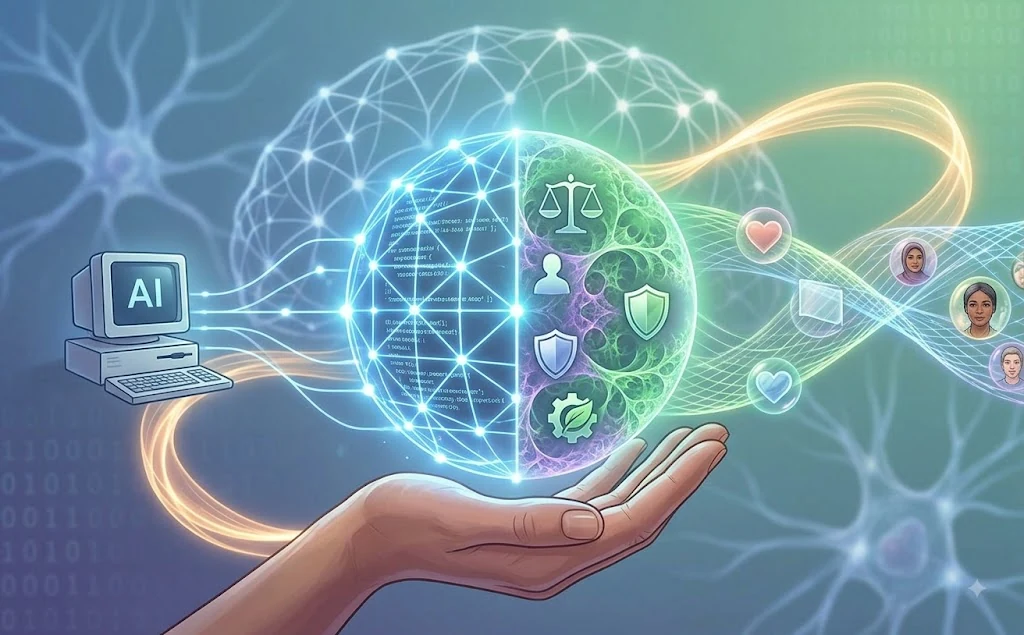
as an intellectual framework that seeks to move artificial intelligence beyond mere Generative Intelligence toward a model that is more closely connected to humans, values, ethics, and responsibility.
From Generative AI to Human-Centered Generative AI
Traditional generative artificial intelligence focuses primarily on:
generation, speed, accuracy, and interaction.
But the next generation needs to add other layers:
understanding + context + ethics + responsibility + transparency + human impact.
Thus, the equation becomes:
Generative AI
What can I generate?
Then:
AtheraEthos
What should I generate?
Then:
Why should I generate it?
And:
What impact will it have on the human being?
This shift represents a transition from intelligence that produces content to intelligence that considers the impact of the content it produces.
Artificial Intelligence That Understands That “No” May Be Better Than “Yes”
One of the most important indicators of responsible artificial intelligence is that the system should not be measured solely by its ability to carry out a request.
In some situations, the best response may be:
to stop.
Or:
to ask for clarification.
Or:
to warn about risks.
Or:
to suggest a safer alternative.
Here, an important concept emerges in the new generation:
Ethical Generative Intelligence
Meaning that the system does not operate according to the principle:
““Execute everything the user is capable of requesting.””
But rather according to the principle:
““Help the user as much as possible without sacrificing safety, humanity, and responsibility.””
From Intelligence That Knows to Intelligence That Understands
Systems may be capable of accessing vast amounts of information.
But knowledge alone does not mean wisdom.
A system may know:
how to make something.
But the question is:
Should it make it?
It may know:
how to persuade someone.
But the question is:
Is using this ability in this context ethical?
It may know:
how to predict user behavior.
But the question is:
Does it have the right to use that prediction in this way?
This gap between capability and responsibility is one of the most important challenges facing the next generation of artificial intelligence.
AtheraEthos.. Artificial Intelligence That Places the Human at the Center of the Equation
AtheraEthos can be viewed as a framework that places a set of principles at the heart of generative artificial intelligence:
Human First
The purpose of artificial intelligence is to enhance human capabilities, not diminish human value or replace human judgment in areas that require human responsibility.
Ethics in Design
Ethics should not be added after the system has been built.
Rather, it should be integrated into the design phase itself:
Ethics by Design.
Transparency
The more a decision affects human beings, the greater the need to explain it and understand its limitations.
Responsibility
The phrase:
““The algorithm decided””
cannot be used as a means of escaping responsibility.
There must be entities and individuals accountable for designing, developing, and using the system.
Respect for Privacy
Data is not merely fuel for algorithms.
It may be part of a person’s identity and rights.
Fairness
The system should seek to reduce bias and discrimination resulting from data, design, or the way it is used.
The New Generation Does Not Only Generate Content.. It Measures Its Impact
The evolution of generative artificial intelligence can be imagined through several stages.
First Generation:
Generate
The system produces content.
Second Generation:
Generate + Personalize
The system produces content tailored to the user.
Third Generation:
Generate + Explain
The system produces content and explains certain aspects of how it arrived at the result.
Fourth Generation:
Generate + Explain + Evaluate
The system attempts to evaluate risks, quality, and context.
Fifth Generation:
Generate + Explain + Evaluate + Ethical Reasoning + Human Oversight
Here, the philosophy of AtheraEthos can emerge as a vision for the next generation of responsible generative artificial intelligence.
What Does This Mean in Practice?
Suppose a student asks an intelligent system to write an entire research paper.
Traditional artificial intelligence may simply generate the paper.
But a more advanced system may say:
I will help you build the research paper, but I will identify the sections that require verification and original sources, distinguish between generated content and source-based information, and help you develop your own ideas instead of eliminating your role as a researcher.
Here, artificial intelligence is no longer merely a text-generation machine.
Rather, it becomes:
a partner in learning.
In medicine, it may assist in analyzing information, but it does not turn prediction into a final diagnosis.
In education, it may support the student and the teacher, but it does not turn the algorithm into the final judge of a student’s abilities.
In administration, it may suggest decisions, but it does not eliminate the responsibility of the decision-maker.
From AI Assistant to AI Ethical Partner
This transformation may redefine the concept of the intelligent assistant.
The traditional assistant says:
““What do you want me to do?””
But a more advanced assistant may ask:
““What goal do you want to achieve? What are the constraints? What are the risks? And what is the best way to achieve it?””
In other words, it moves from:
Command Following
to:
Context-Aware Assistance
and then to:
Ethically Guided Assistance
Here, understanding context becomes a fundamental element of intelligence.
Generative Artificial Intelligence and Human Decision-Making
Responsible artificial intelligence does not mean that humans should reject technology.
Quite the opposite.
What is required is to build a more intelligent relationship between humans and machines.
It can be envisioned as follows:
Human Goal
↓
Generative AI
↓
Context Understanding
↓
Ethical & Risk Evaluation
↓
Explainable Recommendation
↓
Human Review
↓
Final Human Decision
This is not a relationship of:
Human vs AI
but rather:
Human + AI
Why Do We Need This Generation Now?
Because the power of generative artificial intelligence is growing rapidly.
And as the ability to generate increases, so does the ability to:
influence, persuade, personalize, simulate, and produce information.
This means that an error is no longer merely a technical error.
It may become:
an educational, medical, economic, social, or legal error.
Therefore, the question of artificial intelligence ethics is no longer a philosophical issue detached from reality.
It has become a question about:
the future of society itself.
AtheraEthos and the Transition from “Intelligence” to “Responsible Intelligence”
The core value of any new generation of artificial intelligence should not be measured solely by indicators such as:
Accuracy
or:
Speed
or:
Scale.
We should also add:
Safety
Explainability
Fairness
Privacy
Accountability
Human Impact
Thus, we may arrive at a new equation:
AI Value = Capability × Responsibility × Human Benefit
High capability without responsibility may amplify risks.
Responsibility without capability may make the system of limited usefulness.
But combining both creates artificial intelligence that is more valuable to humans.
From Artificial Intelligence to “Augmented Human Intelligence”
The ultimate goal is not for the machine to become more human in the literal sense.
A machine is not a human being.
Rather, the goal is for technology to become more aligned with human needs and values.
Here, AtheraEthos can represent a vision based on:
Human-Centered
The human being is at the center of the design.
Ethical
Ethics are part of the system.
Explainable
Decisions are understandable and reviewable to the greatest extent possible.
Responsible
There is clear accountability for how the system is used.
Adaptive
The system adapts to context without abandoning its core principles.
The Future.. Will We Build Artificial Intelligence That “Knows When to Stop”?
Perhaps this is one of the most important questions for the next generation.
True intelligence is not only the ability to produce more.
It is also the ability to know:
When should we generate?
What should we generate?
For whom?
Why?
And what are the consequences?
Perhaps the greatest development in generative artificial intelligence will not be its ability to answer more questions.
But its ability to ask the right questions before answering.
Conclusion
We are entering a new stage in the history of artificial intelligence.
A stage in which the primary challenge is no longer:
Can the machine generate?
But rather:
Can it generate responsibly?
From this perspective, AtheraEthos presents a vision for a new stage of generative artificial intelligence; a stage that combines:
generative capability + context understanding + explainability + ethics + responsibility + human oversight.
It is a call to move from:
Generative AI
to:
Ethical Generative AI
and then to:
Human-Centered Generative Intelligence
The artificial intelligence that will lead the future will not necessarily be the one most capable of producing content.
It may instead be the one most capable of understanding that behind every piece of content is a human being, behind every decision is an impact, and behind every technology is a responsibility.
AtheraEthos.. because the next generation of artificial intelligence should not only be more intelligent, but also more aware of the human being.