Dr. Doaa Mohi El-Din: From Artificial Intelligence to Predictive Medicine: A Scientific Vision for a More Humane Medicine
Artificial Intelligence and Waste Management.. When Waste Transforms from an Environmental Burden into Economic Wealth
By Dr. Doaa Mohi El-Din, Faculty Member at the Faculty of Computers and Information Systems and Consultant in Artificial Intelligence and Data Science
From the Waste Bin to the Smart Factory.. How Is Artificial Intelligence Reshaping the Future of Recycling and the Circular Economy?
The waste crisis is no longer only an environmental issue, but has become one of the most important economic and social challenges facing modern cities. Every day, societies generate enormous quantities of waste, while a large percentage of it is still collected, transported, buried, or burned without fully benefiting from its economic value.
But the digital revolution is opening a new door.
What if waste became “data” first.. and then raw materials?
Here, artificial intelligence emerges as one of the most important technologies capable of redefining the waste life cycle, from the moment it is produced until it is collected, sorted, recycled, and reintroduced into the economy.
From “Waste Management” to “Waste Intelligence”
The traditional model relies on:
Collection → Transport → Sorting → Disposal.
But the intelligent model can become:
Sensing → Classification → Prediction → Optimization → Smart Sorting → Recycling → Reuse.
Here, artificial intelligence transforms from a technical tool into the operational brain of the waste management system.
The Camera That Distinguishes Between Plastic and Metal
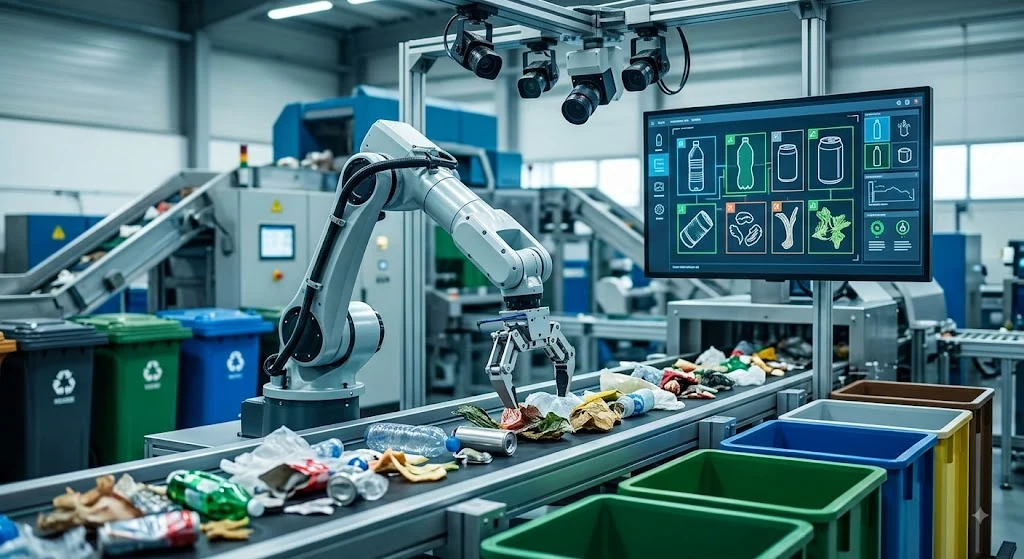
One of the most important applications of artificial intelligence is the use of Computer Vision to identify different types of waste.
Computer vision models can be trained to identify:
plastic, paper, cardboard, metals, glass, organic waste, electronics, and others, depending on the system and the data used.
When waste reaches the sorting line, cameras and sensors can analyze the items present and then direct them to the appropriate path.
In this way, the recycling line can become faster, more accurate, and less dependent on manual sorting alone.
Artificial Intelligence Does Not Just See Waste.. It Learns from It
The real power does not lie in identifying a single piece of plastic.
It lies in analyzing millions of items over time.
The system can learn:
What types of waste are most common?
When do they increase?
Which areas produce the largest quantities?
What percentage of materials is recyclable?
Which types of materials appear most frequently?
Through this data, models can be built to predict future quantities.
Here, we move from:
Reactive Waste Management
to:
Predictive Waste Management.
In other words, managing waste before the problem fully emerges.
The Waste Bin Becomes “Smart”
Artificial intelligence can be integrated with the Internet of Things and sensors to develop bins capable of measuring their fill level.
Instead of a waste collection vehicle passing according to a fixed schedule, the system can analyze the data and determine:
Which bins need to be collected?
When?
And in what order?
This creates opportunities to optimize collection vehicle routes and reduce unnecessary trips.
Artificial Intelligence and Smart Waste Collection Routes
Imagine a city containing thousands of bins.
Instead of collection vehicles moving along fixed routes, the system can analyze:
bin fill level + traffic + distance + waste type + collection priority
and then suggest a more efficient route.
This can reduce:
time, fuel, distance, and operating costs.
Here, waste management becomes part of the concept of:
Smart City.
From Sorting to “Material Value”
One of the most important transformations artificial intelligence can enable is viewing waste as materials with value.
A plastic bottle in a waste bin may be:
waste.
But after classification, processing, and recycling, it can become:
raw material.
Here, the relationship between artificial intelligence and the Circular Economy becomes clear.
The goal is not merely to dispose of waste.
Rather:
to keep resources within the production cycle for as long as possible.
Artificial Intelligence and Reducing Food Waste
Artificial intelligence applications are not limited to plastics and metals.
Predictive analytics can be used in food sectors to help forecast demand and reduce excess production or storage, potentially contributing to a reduction in food waste.
Computer vision can also be used in some applications to classify organic waste and monitor treatment processes.
In this way, technology can support the chain:
Food → Consumption → Waste → Recovery.
Electronic Waste.. A More Complex Challenge
With the widespread use of electronic devices, electronic waste has become an important global issue.
Artificial intelligence can help identify different types of devices and components, classify them, and determine appropriate processing pathways.
Electronic devices may contain materials that can be recovered and reused, making intelligent sorting an important tool for resource recovery.
Robotics and Artificial Intelligence in Recycling Plants
The combination of:
AI + Robotics + Computer Vision
can create more automated sorting lines.
The camera sees.
The algorithm classifies.
The robot picks.
The system learns from the results.
In this way, sorting can become an intelligent cycle:
See → Understand → Decide → Act → Learn
This is the essence of intelligent systems.
Artificial Intelligence and Environmental Decision-Making
Data generated by the waste management system can be used to help decision-makers answer questions such as:
Where do we need new recycling plants?
Which types of waste are the most economically important?
Which areas are most in need of collection services?
What level of investment is required?
What impact would increasing recycling rates have on the amount of waste sent to landfills?
In this way, artificial intelligence becomes a tool for supporting environmental and economic policies.
From “A Ton of Waste” to “A Ton of Recovered Resources”
This may be the most important shift in the way we think.
In the traditional model, we ask:
“How many tons of waste did we produce?”
But the circular economy asks:
“How many tons of resources were we able to recover?”
This changes the indicators themselves.
Performance indicators can become:
Recovery rate
Recycling rate
Value of recovered materials
Emissions reduction
Reduction in collection costs
Reduction in waste sent to landfills.
Here, waste becomes part of a data-driven economy.
Artificial Intelligence and Sustainability
Improving collection, sorting, and recycling processes can contribute to environmental and economic goals, but the actual impact depends on system design, energy sources, treatment efficiency, and the supply chain.
Therefore, artificial intelligence should not be viewed as a magical solution.
Rather, it should be viewed as an enabling tool within an integrated system.
The Challenge: Can Artificial Intelligence Itself Become Part of the Problem?
Yes, if it is used without proper planning.
Intelligent systems require:
data, devices, energy, infrastructure, and maintenance.
Electronic devices that reach the end of their useful life can also become waste themselves.
Therefore, the design should be based on:
Green AI
meaning the development of artificial intelligence systems that are more efficient in their consumption of energy and resources.
Toward Smarter “Zero Waste”
The future may move toward an interconnected system:
Smart Bins
↓
IoT Sensors
↓
Computer Vision
↓
AI Classification
↓
Smart Collection
↓
Robotic Sorting
↓
Recycling
↓
Material Recovery
↓
Circular Economy
Here, the city itself becomes a system that learns from the waste it produces.
The Future Vision
We may reach a stage where waste is no longer viewed as the end of a product’s life cycle.
But rather as:
the beginning of a new cycle.
The product reaches the end of its use.
Then it becomes material.
Then the material returns to production.
Artificial intelligence helps determine:
What is the material?
Where is it located?
What is its value?
How can it be recovered?
And where should it go?
The idea can be summarized in the following equation:
AI + Waste Management + Recycling + Circular Economy = Smart Resource Recovery
Meaning that artificial intelligence does not only help us dispose of waste, but can also help us discover the resources hidden within it.
Conclusion
The smart cities of the future will not be measured only by the number of sensors or the speed of the internet.
They will also be measured by their ability to manage resources efficiently.
Waste will be one of the most important tests.
A city that is able to know:
what waste it produces, where it is produced, how it is collected, how it is sorted, how it is recycled, and what value can be recovered from it
is a city moving closer to the model of an intelligent circular economy.
Artificial intelligence does not view waste as “something that must be disposed of”..
but rather as “data, materials, and resources waiting for us to discover their value”.