Dr. Doaa Mohi El-Din: From Artificial Intelligence to Predictive Medicine: A Scientific Vision for a More Humane Medicine
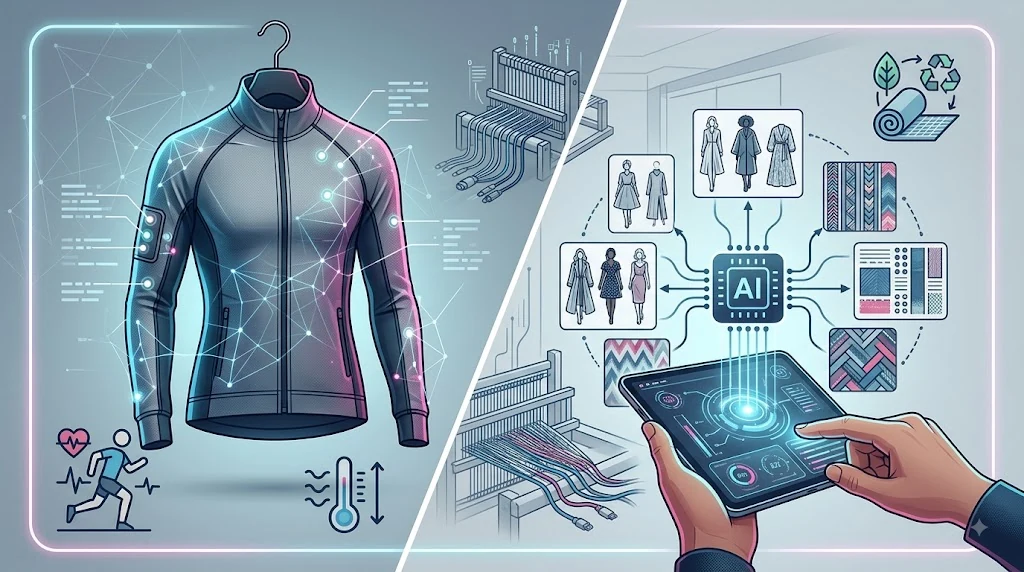
Artificial Intelligence and Smart Clothing Design.. When Fashion Transforms from “Appearance” into an “Intelligent System”
By Dr. Doaa Mohi, Faculty Member at the Faculty of Computers and Information Systems and Consultant in Artificial Intelligence and Data Science
From a dress that changes its design to clothing that monitors the environment and responds to the body.. How is artificial intelligence redefining the future of fashion?
The fashion industry is no longer based only on choosing colors, fabrics, and aesthetic designs. Technological development is pushing fashion toward a new stage in which clothing itself becomes part of an intelligent digital system.
With artificial intelligence, sensors, the Internet of Things, flexible electronics, and nanotechnology entering the textile industry, the features of a new generation of clothing are beginning to emerge—clothing that can sense the environment, interact with the user, collect data, and even adapt to certain surrounding conditions.
Here, the question arises:
What if clothing were no longer merely something we wear, but became an intelligent technology that interacts with us?
From Fashion Design to Fashion Engineering
In traditional design, the designer begins with an idea, then selects the material, color, and form, creates a prototype, and then tests and modifies it.
Artificial intelligence, however, can be integrated into multiple stages of this process.
Algorithms can analyze:
fashion trends + consumer preferences + colors + fabrics + market data + previous designs
and then suggest new designs.
Here, artificial intelligence does not become merely a drawing tool, but rather a partner in the design process.
Generative Design.. The Designer That Can Produce Thousands of Possibilities
One of the most prominent future applications is:
Generative AI for Fashion
where the system can generate a large number of designs based on a set of requirements.
For example:
“Design lightweight sportswear that is heat-resistant, suitable for outdoor activities, and has a modern style.”
The system can suggest dozens or hundreds of different concepts.
The designer then selects the most suitable one and develops it further.
Here, the role of the designer does not disappear, but changes.
The human defines the vision.. and artificial intelligence expands the space for creativity.
Clothing That “Understands” the Environment
The most exciting stage begins when sensors and flexible electronics are added.
Clothing can be developed to sense certain variables such as:
temperature, humidity, movement, pressure, and certain biological indicators depending on the type of sensor and application.
The system can then analyze this data to determine an appropriate response.
In this way, clothing transforms from:
Passive Clothing
to:
Responsive Clothing
meaning clothing that responds to the environment or the user.
Clothing That Adapts to Temperature
Imagine clothing that uses advanced materials or intelligent systems to help regulate the user’s thermal comfort.
When the temperature rises, certain properties of the fabric or ventilation may change in advanced designs.
When the temperature drops, the response may change according to the technology used.
Here:
AI + Smart Materials + Textile Engineering
come together to build clothing that is more capable of adaptation.
Smart Clothing and Healthcare
One of the most important fields that may benefit from smart clothing is:
Wearable Health Technology
Clothing can become a platform for carrying sensors that monitor certain biological or movement-related indicators.
Future applications may include, depending on device design and medical approval:
Monitoring movement.
Analyzing physical activity.
Monitoring certain physiological indicators.
Detecting unusual changes.
Supporting rehabilitation.
Assisting certain groups that require continuous monitoring.
But there must be one fundamental rule:
Medical smart clothing does not mean that every piece of clothing has become a medical device.
Any health-related use must undergo appropriate scientific and regulatory validation.
Artificial Intelligence Does Not Simply Collect Data
Collecting data alone is not the goal.
The real value begins when artificial intelligence can analyze it.
For example, if sportswear collects movement data, the system can analyze movement patterns and detect changes that may indicate fatigue or variations in performance.
Here, the system becomes:
Sensors → Data → AI → Pattern Recognition → Insight
meaning:
sensors → data → artificial intelligence → pattern recognition → actionable information.
Smart Clothing for People with Special Needs
This field can have a significant human impact.
Smart clothing can be designed to assist people with different needs through:
Alerting them to certain risks.
Supporting movement.
Providing alternative means of interaction.
Assisting in certain rehabilitation programs.
Supporting communication in specific applications.
Here, intelligent design becomes not merely a luxury, but a means of achieving:
Inclusive Fashion
meaning fashion that is more inclusive and accessible to different segments of society.
Artificial Intelligence and Sustainability in the Clothing Industry
The fashion industry faces major challenges related to consumption and waste.
Artificial intelligence can help analyze demand, forecast sales, and optimize production processes.
If a factory becomes better able to predict demand, it can reduce the production of items that may not find buyers.
Artificial intelligence can also be used for:
optimizing material use, reducing waste, improving supply chains, and supporting recycling.
In this way, smart clothing can become part of the concept of:
Sustainable Fashion
and not merely Fashion Technology.
Nanotechnology Enters the World of Clothing
Nanotechnology also opens important possibilities in fabric development.
Nanotechnology can be used to develop materials with enhanced properties, depending on the application, such as:
water resistance, improved protection from radiation, antimicrobial properties, or enhanced mechanical and thermal characteristics.
When nanotechnology is combined with artificial intelligence, modeling and data analysis can be used to explore new material combinations and properties.
Here, a new triangle emerges:
AI + Nanotechnology + Smart Textiles
which may become one of the most important future trends in the textile industry.
Can Clothing Become “Programmable”?
This is one of the most exciting ideas in the future of smart clothing.
Instead of clothing properties remaining fixed, some advanced technologies may allow certain properties to change in response to the environment or data.
In the future, this concept may include:
changing appearance, lighting, ventilation levels, or certain functional characteristics.
This opens the door to the concept of:
Programmable Fashion
meaning fashion that can change or respond according to specific conditions.
But There Is a More Important Question: Who Owns the Data Generated by Our Clothing?
When clothing becomes a sensor connected to a phone or the internet, it may generate data about the user.
This raises important issues:
privacy, data security, consent, data ownership, and commercial use.
If clothing knows when we move, how we move, and perhaps certain biological indicators, then this data must be treated as sensitive information depending on its nature and intended use.
Therefore, smart clothing should be designed according to the principles of:
Privacy by Design
and
Security by Design.
Will the Fashion Designer Disappear?
Quite the opposite.
Artificial intelligence may change the nature of the designer’s role, but it does not necessarily eliminate human creativity.
A machine can generate thousands of designs, but it does not necessarily possess the cultural and human vision, taste, and social context that give a design meaning.
Therefore, the designer of the future may become:
Fashion Designer + AI Designer + Data Interpreter + Technology Collaborator.
In other words, the designer will work with artificial intelligence rather than compete against it.
Toward the “Cognitive Designer”
We can go even further.
What if the design system became capable of understanding:
the user + the environment + the occasion + movement + culture + personal preferences?
And then suggested a design that adapts to these factors?
Here, we move from:
Smart Fashion
to:
Cognitive Fashion
meaning fashion that uses artificial intelligence to understand context and provide a response that is more suitable for the user.
The Future: Clothing as a Technology Platform
Perhaps the greatest transformation in the fashion industry will be that we stop viewing clothing as a finished product.
Clothing may become:
an interaction interface.
a sensing platform.
a means of protection.
a health tool.
part of the Internet of Things ecosystem.
and a tool for sustainability.
Here, the future is no longer:
““What will we wear?””
but rather:
““What will our clothes do for us?””
Conclusion
Artificial intelligence is not only redesigning clothing, but redefining the very concept of clothing itself.
By combining:
Artificial Intelligence
and
Generative AI
and
Smart Textiles
and
IoT
and
Nanotechnology
we can gradually move from traditional clothing toward garments that:
understand the environment, respond to the user, collect data, support health, contribute to sustainability, and open new spaces for creativity.
But all this development must progress in parallel with:
ethics, privacy, security, transparency, and human oversight.
The true future of fashion is not merely for clothing to become more intelligent.
But for it to become more useful, safer, and more human-centered.
Perhaps the day will come when the question is no longer:
“Is this smart clothing?”
but rather:
“To what extent can our clothes understand us?”