
12 Trends Reshaping the Future of Artificial Intelligence
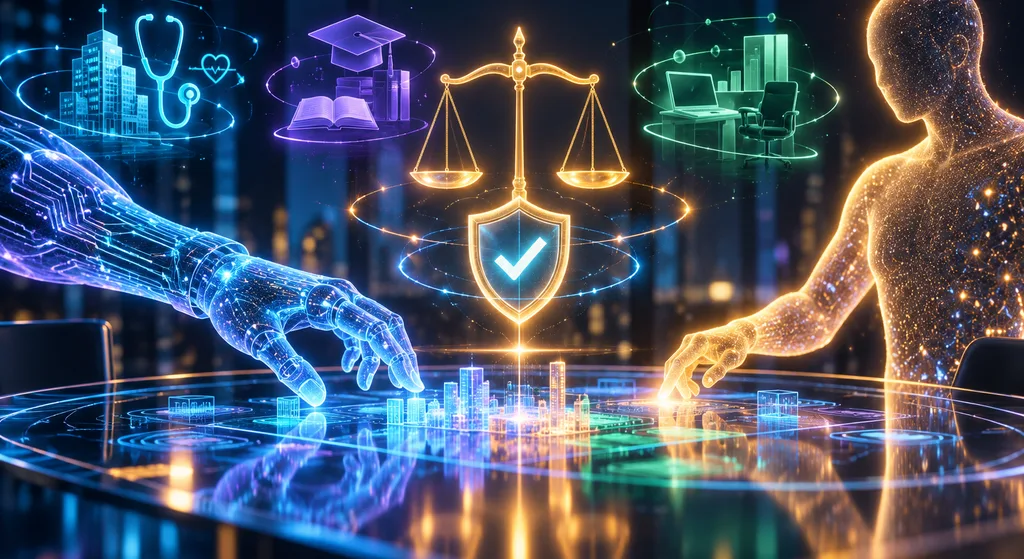
With the rapid development of artificial intelligence, the future of jobs has become one of the most debated topics worldwide. While some fear that machines will replace people, the modern scientific view, in line with UNESCO’s framework on the ethics of artificial intelligence (UNESCO Recommendation on the Ethics of AI, 2021), sees artificial intelligence as a partner that supports people rather than a substitute for them, provided it is developed within an ethical system that puts the human at the centre.
First: AI and Jobs, Between Reality and Global Fear
World Economic Forum reports (WEF 2023–2024) indicate that artificial intelligence will affect the labour market in two ways:
Creating 97 million new jobs linked to AI, data and automation
While, on the other hand, possibly bringing a radical change to the nature of 85 million traditional jobs
But these figures do not mean complete replacement; they mean reshaping the skills that are needed, which is consistent with UNESCO’s view that the aim is “to enhance human work, not to replace it”.
Second: UNESCO’s Ethical Principles for Artificial Intelligence
The UNESCO Charter (2021) rests on a set of core principles that form the most comprehensive global framework to date. The most important are:
1. Putting the Human at the Centre (Human-Centered AI)
All AI systems must serve people, not the other way round.
In practice:
In the medical sector, artificial intelligence is used to analyse X-rays, but the final decision remains with the doctor.
2. Transparency and Explainability
It must be clear how intelligent systems reach their decisions.
Example:
In smart recruitment systems, applicants should know why their application was rejected or accepted.
3. Fairness and Non-Bias
Preventing discrimination based on:
Gender
Race
Age
Social background
A real example:
MIT and Stanford studies (2023) showed that some smart recruitment systems can show bias of up to 20–30% if the data is not properly calibrated.
4. Privacy and Data Protection
UNESCO stresses that data is not just a technical resource but “a human right”.
A statistic:
According to IBM’s Cost of a Data Breach report (2024), the average global cost of a data breach exceeded 4.5 million dollars per incident.
5. Accountability and Human Responsibility
A machine does not bear legal or moral responsibility.
This is a decisive principle in:
Medicine
The judiciary
Recruitment
Education
Third: AI as a “Smart Partner” in the Labour Market
According to the modern view, people are not replaced; roles are redistributed:
In medicine:
Artificial intelligence: analysing X-rays and detecting tumours
The doctor: the final diagnosis and human communication
Example:
AI systems in radiology reach an accuracy of up to 94–97% in detecting some tumours, but they still need the doctor to confirm the decision.
In education:
Artificial intelligence: analysing student performance and personalising content
The teacher: guidance, upbringing and building values
A statistic:
UNESCO Education Reports indicate that AI-personalised learning can improve academic performance by 20–30% in some educational settings.
In the labour market:
Artificial intelligence: automating routine tasks
People: creativity, leadership and ethical decision-making
Fourth: Ethical Challenges in the Light of the UNESCO Charter
Although the principles are clear, there are practical challenges:
1. The implementation gap between countries
Developed countries apply ethical standards faster than developing countries.
2. The “black box”
Some deep models are still not fully explainable.
3. Bias in data
If the data is biased, the decisions are biased.
4. The digital divide
Unequal access to AI technologies.
Fifth: From UNESCO’s Perspective, Towards a Human + AI Economy
The Charter stresses that the future is not built on:
Human versus machine
But on: Human + Artificial Intelligence = a fair, productive partnership
This requires:
Reskilling and upskilling
Teaching artificial intelligence in schools and universities
National legal and ethical frameworks aligned with UNESCO
Sixth: A Vision for the Future
The concept of the “smart partner” is no longer a philosophical option; it has become a global direction backed by international standards. When artificial intelligence works within an ethical framework such as the UNESCO Charter, which is one of the goals of AtheraEthos AI, founded by Dr. Doaa Mohey Eldin, the direction becomes a new generation of artificial intelligence that is:
Fairer
More transparent
And more in the service of people
In return, the human remains:
The source of values
The decision-maker
And the guardian of the moral compass
The future of jobs in the age of artificial intelligence is not built on replacement, but on redefining the relationship between people and technology. According to the UNESCO Charter, the safe path is to build a system in which artificial intelligence is a tool of empowerment, not a force of exclusion.
In the end, the most important question is not: will artificial intelligence replace people?
But rather: how do we make sure that artificial intelligence remains in the service of people, preserves their dignity and enhances their abilities in a fairer and more humane world?
By Dr. Doaa Mohey Eldin, AI and Data Science Expert and Consultant, Faculty Member in Artificial Intelligence